Skip to content

How do we know? Because IPCC

  • Menu
    • Home
    • Donate (we’re a charity)
    • Praise for Because IPCC
    • Volunteer
    • About
    • Terms of Use – Privacy – Credits – Copyright – Contact
    • Because IPCC is a project of the Canadian charity Succession, charitable number 854745940RR0001

pg14

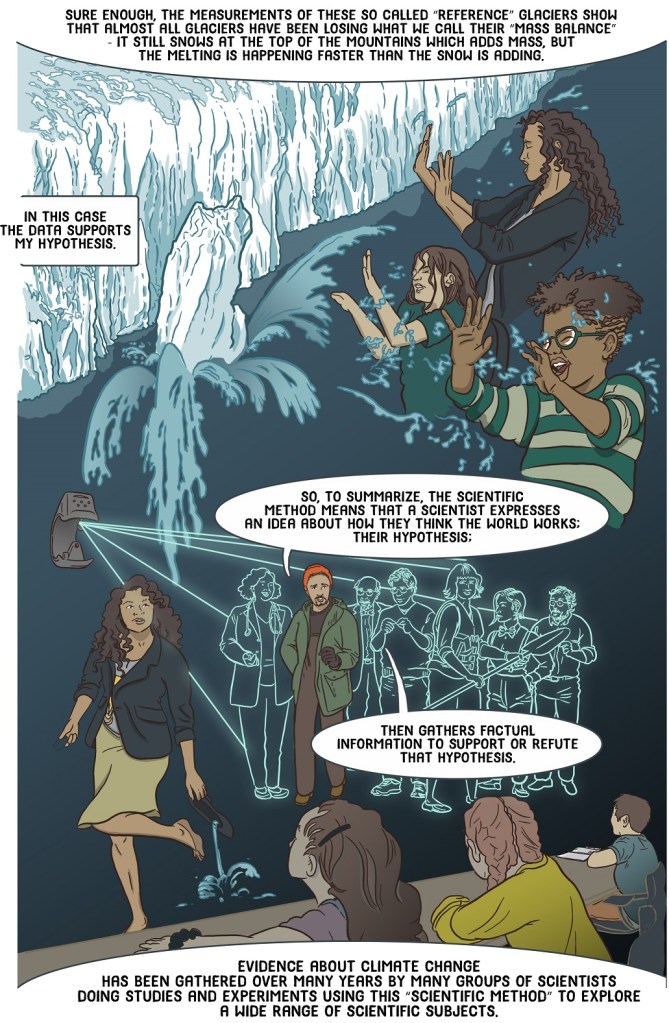
Twelfth online page shows explanation continuing as students get splashed from virtual glacier meltwater. Teacher then summarizes. Goes on to generalize across many studies
Dialogue:
Sure enough, the measurements of these so called “reference” glaciers show that almost all glaciers have been losing what we call their “mass balance” - it still snows at the top of the mountains which adds mass, but the melting is happening faster than the snow is adding.
So the data supports my hypothesis.
So, to summarize, the scientific method means that a scientist expresses an idea about how they think the world works; their hypothesis; then gathers factual information to support or refute that hypothesis.
Evidence about climate change has been gathered over many years by many groups of scientists doing studies and experiments using this “scientific method” to explore a wide range of scientific subjects.
12 of 31
October 1, 2020October 29, 2021

pg15

Thirteenth online page shows tree scientist in a forest explaining scientific reports and scientific journals and peer review.
Dialogue:
Scientists write up a report of their results so other scientists will know what they found out. But it isn’t as easy as just writing it down.
Oh, here’s Dr Silva to explain.
Hi everyone. I study the world’s climate as it’s been recorded by trees.
When I write a report I want to get the most people I can to read it.
So I submit the report, also called “a paper,” for publication in a scientific journal.
But the journal won’t just take my word for it that my research is so great; that my findings are so wonderful and interesting.
Instead they ask a bunch of other scientists first. Other experts who understand how the world’s climate affects its trees.
They don’t tell me who the other scientists are. They’re anonymous.
They are my peers. That’s why it’s called peer review.
13 of 31
October 1, 2020October 29, 2021

pg16

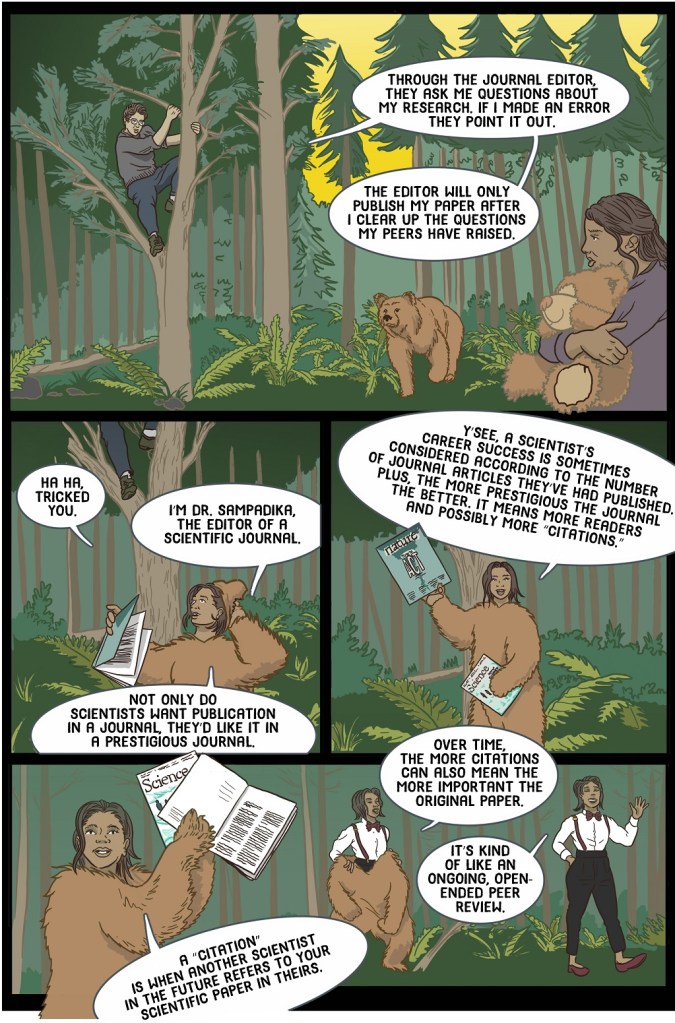
Fourteenth online page shows a bear in the virtual forest approaching the scientist but revealing itself to be a science journal editor in disguise, who discusses journal article citations. 
Dialogue:
Through the journal editor they ask me questions about my research. If I made an error they point it out.
The editor will only publish my paper after I clear up the questions my peers have raised.
Ha ha, tricked you.
I’m Dr Sampadika, the editor of a scientific journal.
Not only do scientists want publication in a journal, they’d like it in a prestigious journal.
Y’see, a scientist’s career success is sometimes considered according to the number of journal articles they’ve had published. Plus, the more prestigious the journal the better. It means more readers and possibly more “citations.”
A “citation” is when another scientist in the future refers to your scientific paper in theirs.
Over time, the more citations can also mean the more important the original paper.
It’s kind of like an ongoing, open ended peer review.
14 of 31
October 1, 2020October 29, 2021

Posts navigation

Older posts
Newer posts
How do we know? Because IPCC
  • Subscribe Subscribed
    • How do we know? Because IPCC
    • Already have a WordPress.com account? Log in now.
    • How do we know? Because IPCC
    • Subscribe Subscribed
    • Sign up
    • Log in
    • Report this content
    • View site in Reader
    • Manage subscriptions
    • Collapse this bar
 

Loading Comments...