Skip to content

How do we know? Because IPCC

  • Menu
    • Home
    • Donate (we’re a charity)
    • Praise for Because IPCC
    • Volunteer
    • About
    • Terms of Use – Privacy – Credits – Copyright – Contact
    • Because IPCC is a project of the Canadian charity Succession, charitable number 854745940RR0001

Images

pg13

Eleventh online page of the graphic novel book Because IPCC shows scientist describing scientific method while surrounded by ice fields
Dialogue:
To do a study using the scientific method, first I need a hypothesis, which means a statement that my study can support as being true or, if I was wrong, as being false.
So in this case my hypothesis is that glaciers around the world are getting smaller than they used to be. So how can I test my hypothesis? There are many glaciers in the world… and time is an important factor.
By choosing about 40 glaciers from different places in the world, and studying those closely for several decades, my colleagues and I have gotten a pretty good idea of how all glaciers are behaving.
11 of 31
October 1, 2020October 29, 2021

pg14

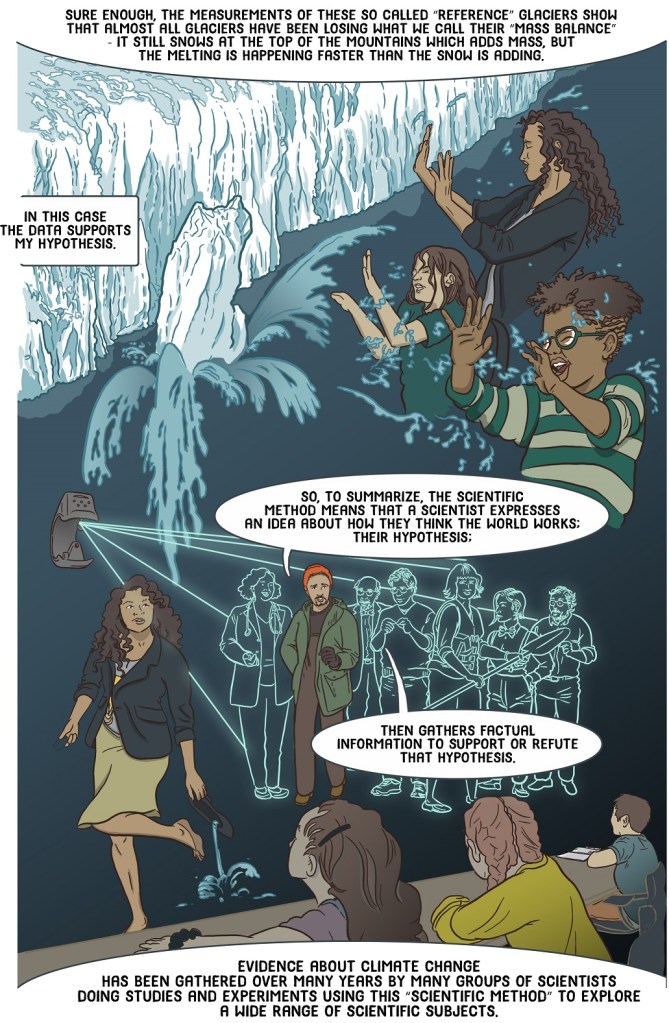
Twelfth online page shows explanation continuing as students get splashed from virtual glacier meltwater. Teacher then summarizes. Goes on to generalize across many studies
Dialogue:
Sure enough, the measurements of these so called “reference” glaciers show that almost all glaciers have been losing what we call their “mass balance” - it still snows at the top of the mountains which adds mass, but the melting is happening faster than the snow is adding.
So the data supports my hypothesis.
So, to summarize, the scientific method means that a scientist expresses an idea about how they think the world works; their hypothesis; then gathers factual information to support or refute that hypothesis.
Evidence about climate change has been gathered over many years by many groups of scientists doing studies and experiments using this “scientific method” to explore a wide range of scientific subjects.
12 of 31
October 1, 2020October 29, 2021

pg15

Thirteenth online page shows tree scientist in a forest explaining scientific reports and scientific journals and peer review.
Dialogue:
Scientists write up a report of their results so other scientists will know what they found out. But it isn’t as easy as just writing it down.
Oh, here’s Dr Silva to explain.
Hi everyone. I study the world’s climate as it’s been recorded by trees.
When I write a report I want to get the most people I can to read it.
So I submit the report, also called “a paper,” for publication in a scientific journal.
But the journal won’t just take my word for it that my research is so great; that my findings are so wonderful and interesting.
Instead they ask a bunch of other scientists first. Other experts who understand how the world’s climate affects its trees.
They don’t tell me who the other scientists are. They’re anonymous.
They are my peers. That’s why it’s called peer review.
13 of 31
October 1, 2020October 29, 2021

Posts navigation

Older posts
Newer posts

Menu

  • Home
  • Donate (we’re a charity)
  • Praise for Because IPCC
  • Volunteer
  • About
  • Terms of Use – Privacy – Credits – Copyright – Contact
  • Because IPCC is a project of the Canadian charity Succession, charitable number 854745940RR0001
Proudly powered by WordPress / Theme: Shoreditch by Automattic.