Skip to content

How do we know? Because IPCC

  • Menu
    • Home
    • Donate (we’re a charity)
    • Praise for Because IPCC
    • Volunteer
    • About
    • Terms of Use – Privacy – Credits – Copyright – Contact
    • Because IPCC is a project of the Canadian charity Succession, charitable number 854745940RR0001

Images

pg16

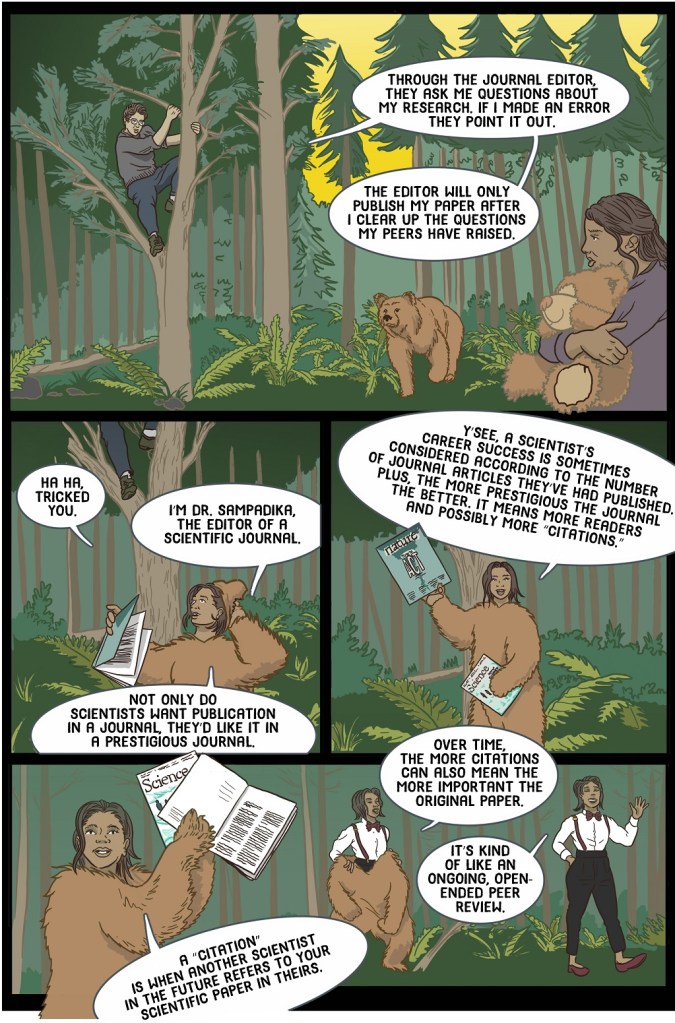
Fourteenth online page shows a bear in the virtual forest approaching the scientist but revealing itself to be a science journal editor in disguise, who discusses journal article citations. 
Dialogue:
Through the journal editor they ask me questions about my research. If I made an error they point it out.
The editor will only publish my paper after I clear up the questions my peers have raised.
Ha ha, tricked you.
I’m Dr Sampadika, the editor of a scientific journal.
Not only do scientists want publication in a journal, they’d like it in a prestigious journal.
Y’see, a scientist’s career success is sometimes considered according to the number of journal articles they’ve had published. Plus, the more prestigious the journal the better. It means more readers and possibly more “citations.”
A “citation” is when another scientist in the future refers to your scientific paper in theirs.
Over time, the more citations can also mean the more important the original paper.
It’s kind of like an ongoing, open ended peer review.
14 of 31
October 1, 2020October 29, 2021

pg17

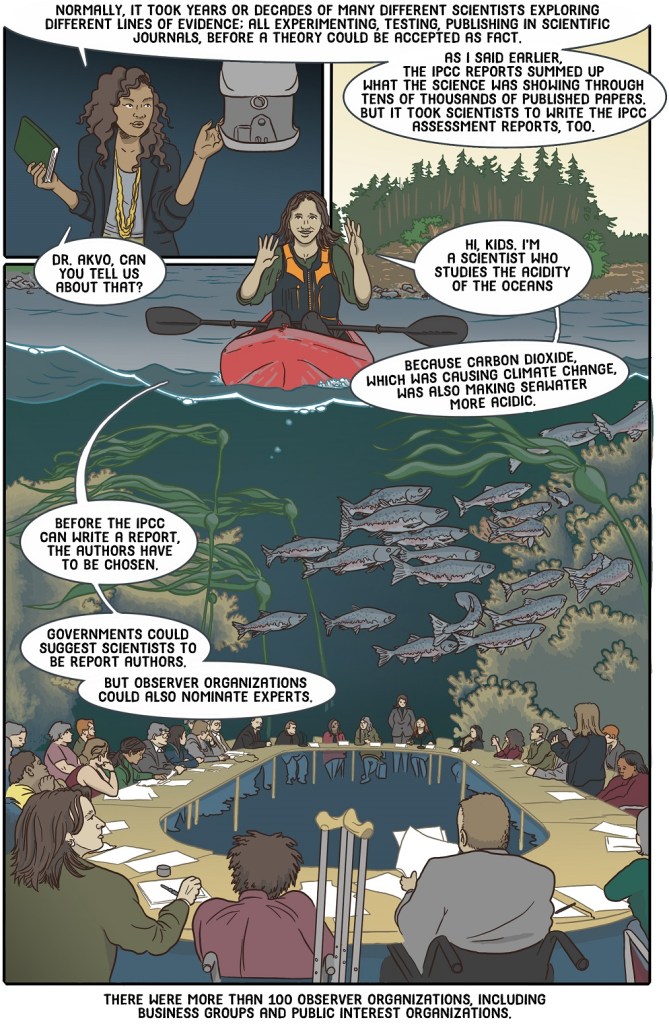
Fifteenth online page shows teacher introducing scientist who studies ocean acidification - she sitting in a kayak with view of sea life - describes who's involved in IPCC
Dialogue:
Normally, it took years or decades of many different scientists exploring different lines of evidence; all experimenting, testing, publishing in scientific journals, before a theory could be accepted as fact.
As I said earlier, the IPCC reports summed up what the science was showing through tens of thousands of published papers.
But it took scientists to write the IPCC assessment reports, too.
Dr Akvo, can you tell us about that?
Hi kids, I’m a scientist who studies the acidity of the oceans because carbon dioxide causing climate change also makes seawater more acidic.
Before the IPCC can write a report, the authors have to be chosen.
Governments could suggest scientists to be report authors.
But observer organizations could also nominate experts.
There were more than 100 observer organizations, including business groups and public interest organizations.
15 of 31
October 1, 2020October 29, 2021

pg18

Sixteenth online page shows scientist in kayak between climate protesters and oil executives, below school children play at seashore with sea life visible
Dialogue
YES the two extremes were there.
Groups like Greenpeace and Environmental Defense as well as industry representatives like OPEC and the World Coal Institute.
They all got to have their say.
IPCC authors were chosen from all over the world to represent the whole of humanity…
...for their scientific and technical expertise, 
but also their gender, country and region of origin.
The consequences of climate change applied to everyone! It was important that the IPCC reports reflected the diversity of the world’s peoples.
They were also careful to keep inviting new scientists into the process so that it wasn’t the same people writing the reports every time.
16 of 31
October 1, 2020October 29, 2021

Posts navigation

Older posts
Newer posts
Menu

  • Home
  • Donate (we’re a charity)
  • Praise for Because IPCC
  • Volunteer
  • About
  • Terms of Use – Privacy – Credits – Copyright – Contact
  • Because IPCC is a project of the Canadian charity Succession, charitable number 854745940RR0001
Proudly powered by WordPress / Theme: Shoreditch by Automattic.